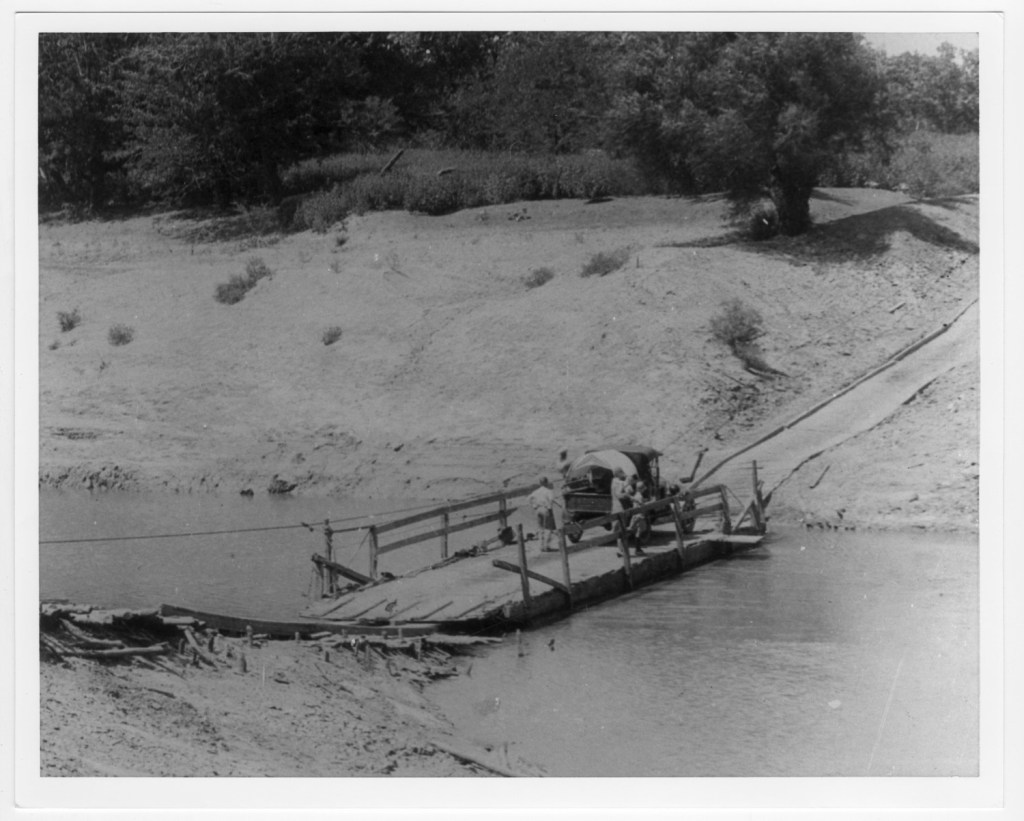
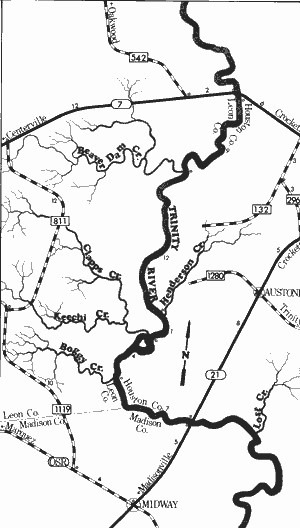
Bonners Ferry was located on the Trinity
River in Anderson County, Texas. During
the late 1870’s, my third great grandfather, James Madison Carter, operated the
ferry.[2]
Before modern bridges were built to span the
Trinity River, ferries were built and placed strategically in areas that were
not fordable. Ferries often had different styles of construction, but the most
common ferry was a flat, raft-like barge which could carry wagons, people and
animals.
As
a part of their charter, ferrymen had to keep the riverbanks graded so that
access to the ferry was not obstructed. Many ferrymen also stretched
bank-to-bank cables as a guide for the ferry crossing. Ferrymen were allowed to
charge for the ferry’s use and were required to post their fares, which
averaged one or two dollars for light and heavy wagons, twenty-five cents for
one man and his horse, six to 12 cents for a man on foot, four to six cents a
head for cattle, and lesser prices for smaller animals. Ferry owners often raises
their fares for crossings at night or during inclement weather.[3]
James Madison Carter was born around 1821 in South Carolina.[4] He was the son of David Carter and Lavinia York. He married Nancy Mayson on 26 November 1846 in Franklin County, Georgia. Together they had six children. After his wife’s death, James moved his family to Catahoula Parish, Louisiana where he met and married Frances Coats.[5] Frances was born in Mississippi and was the daughter of Morgan Coats.[6] The Pine Grove Baptist Church in Rinehart, Louisiana received James Madison Carter as a member of their congregation on 8 June 1861.[7] Other entries from the church record book show him being deeply involved in his church serving as a delegate to represent his church, serving as deacon, being involved in many business transactions, moderator and committee member.[8] An entry recorded on 9 April 1864 shows him making acknowledgment to the church for getting drunk and asking for forgiveness which was granted. On 11 August 1867, James Madison Carter was granted a letter of dismissal upon his request.[9] This was most likely the time he and his family made their move to Texas.
The Carter family is shown in the 1870 census living in Freestone County, Texas and began operating Bonners Ferry in the mid to late 1870’s[10]. James Madison Carter passed away around 1877 leaving his wife Frances with five small children under the age of ten. Frances took over the operation of the Ferry for a short while before moving to Keechi in Leon County to be near her family[11].
[2]
History of Leon County, Texas; compiled and edited by Leon County Historical
Book Survey Committee; sponsored by the Leon County Historical Society, Inc.
and the Leon County Historical Commission; Volume 1; 1986; Dallas, Texas;
Curtis Media Corp.; Carter Family F169 [Matt Rutherford]
[4] 1870
U.S. census, population schedules. NARA microfilm publication M593, Washington,
D.C.: National Archives and Records Administration, Ancestry.com Operations,
Inc.; 2009; Provo, UT, USA; Ancestry.com
[6]
1850 U.S. census, population schedules. NARA microfilm publication M432_230;
Page: 53A; Image: 424; Ancestry.com Operations, Inc.2009; Provo, UT, USA
[7]
Baptist Minute Book, Pine Grove Baptist Church, Rinehart, LA; 8 June 1861; pg
13; Copy of entry in possession of Larry Chapman, 1194 Lamb St. Trout, LA 71371
[10]History
of Leon County, Texas; compiled and edited by Leon County Historical Book
Survey Committee; sponsored by the Leon County Historical Society, Inc. and the
Leon County Historical Commission; Volume 1; 1986; Dallas, Texas; Curtis Media
Corp.; Carter Family F169 [Matt Rutherford]
Week 29 of Amy Johnson Crow’s 52 Ancestors in 52 Weeks Challenge
This week’s word prompt was “Challenging”
Therman Aubrey Carter was my mother’s biological father. He was born on 23 September 1915 in McLennan County, Texas; the son of Claude Wallace Carter, Sr. and Prudie Myrl Westbrook.
Although that sounds like a simple
statement, it took over twenty years of research, frustration, tears, throwing
my hands up in despair and constantly chasing what seemed to be a ghost, until a
couple of years ago, I was finally able to uncover the truth.
Let’s stop and rewind twenty-five years to 1994. I was housewife, a busy mother of three small children, I had a very limited budget, no computer and a friend who just introduced me to the wonderful world of genealogy. I found it all very fascinating as she began to show me her family tree, stories she had written and discoveries she had made. Eagerly, I rushed home, and, in my excitement, I began drawing out a family tree chart on a blank piece of paper. Very quickly, I realized how lopsided it was. I’ve always known that my mother didn’t know who her biological father was, it was not a big secret. Everyone knew that her stepfather adopted her and never thought anything else about it. It never really seemed to be that big of a deal, until I started filling out my family tree.
Who was this mystery man, I wondered? I
couldn’t ask my mother since she passed away when I was 16 years old. Her
mother, my grandmother, passed away two years later, when I was 18 years old
and my great-grandmother was gone as well. There weren’t many people left that I could
ask. I decided to write a letter to each of my grandmother’s two sisters, her
only siblings who were still living. I
wasn’t sure if they knew anything or not, but it was worth a try. Keep in mind,
this was “snail mail”. I didn’t own a computer or have email at that time and
to make a long-distance phone call (no cell phones back then) was an
extravagant expense that I couldn’t afford.
In the meantime, I went to talk to my dad to
ask him if he had ever heard anything about Mom’s birth father. I vaguely
remember hearing that his name was Robert Carter, Howard Carter or maybe
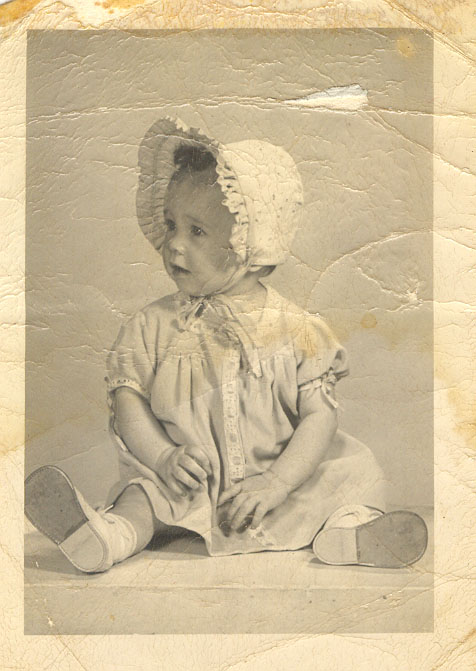
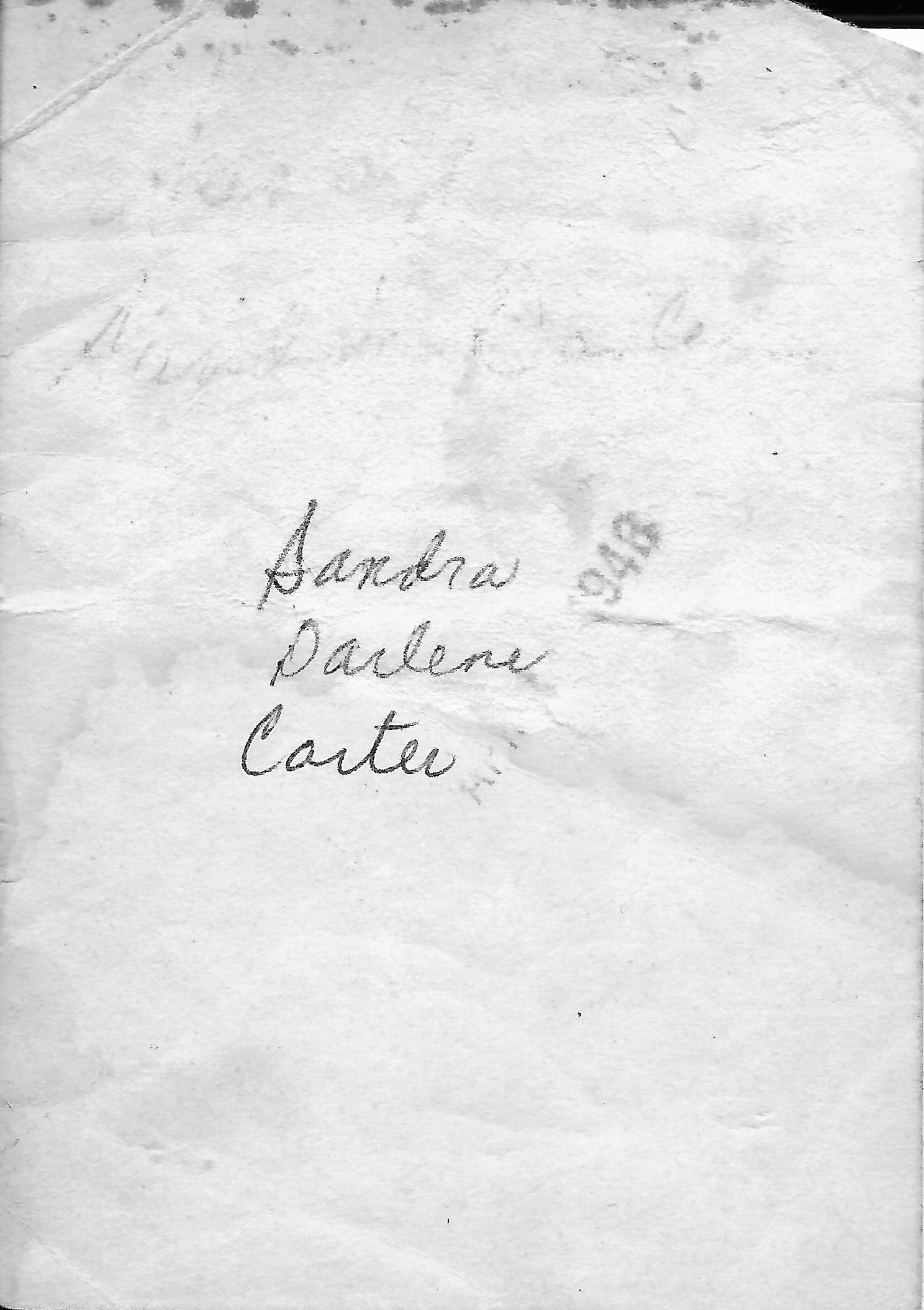
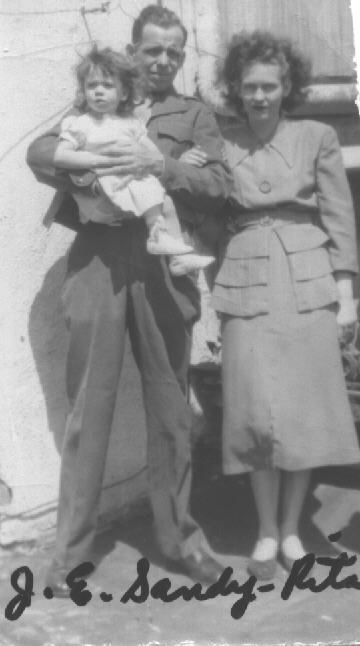
Herald?? We all knew that the last name was Carter because there was a picture
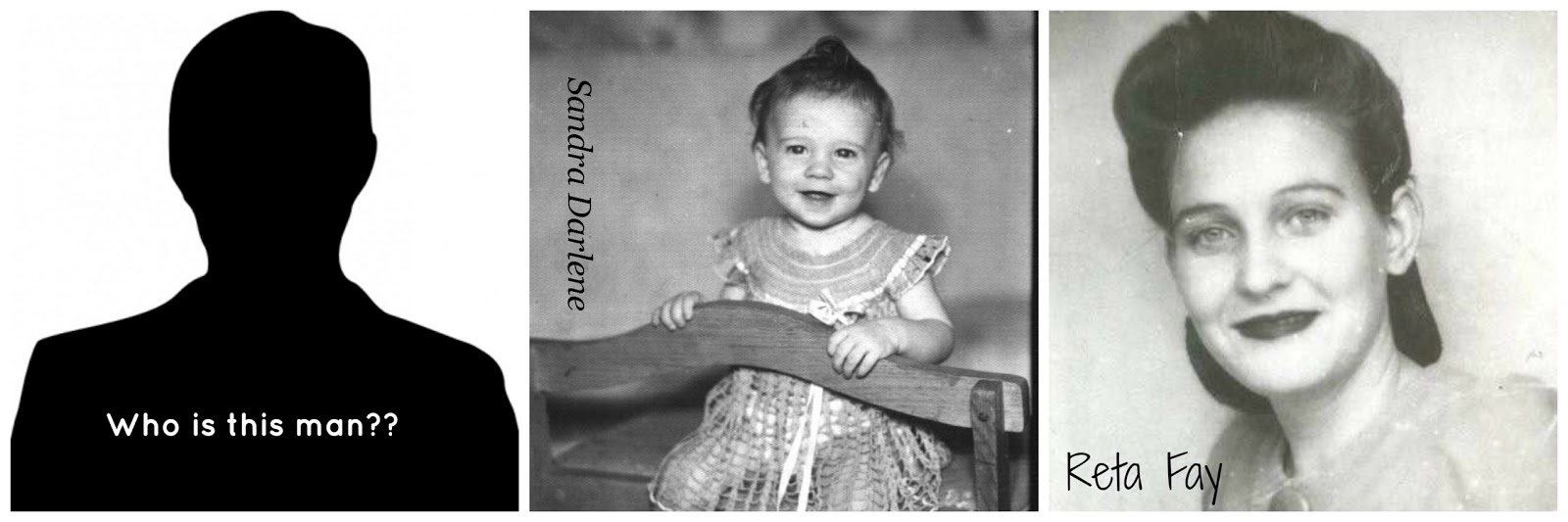
of my mother when she was a small child. The name on the back said Sandra
Darlene Carter. The photo was taken in 1948, which would have been before her
stepfather adopted her.
After speaking with my dad, I learned a little more. He was told by my grandmother that my mother’s birth father was Robert Carter and that he was from Waco. At least now I had a name. He didn’t know much else except that the family owned some type of business in Waco and that mother’s biological father worked there. He also had remembered hearing a story about the one and only time my mother saw her father. My grandmother was at Cameron Park having a picnic with my mother and her other daughter. She (my grandmother) had gone to throw away their trash and when she turned around to go back to the girls, a man was holding my mom. He was her father. My grandmother ran toward them, jerking my mother from his arms and stormed off. She never saw him again.
I heard back from my two aunts eventually
which confirmed the name Robert Carter. They never met him and never asked my
grandmother questions because they respected her privacy.
“Dear Teresa, I wish I could tell you more
about your mother’s father, but I know very very little. His name was Robert
Carter, he lived in Waco. I only saw him once, don’t remember what he looked
like. He had been married, told Reta that he had his divorce but she found out
later that he didn’t, so she left and went to Big Springs Tx where her best
girl friend lived. He came out there and got thrown in jail. I don’t know what
happened. Anyway, (Grannie), my mother and dad went out there and stayed until
Sandra was born, then brought them back to Waco with them. Reta never wanted to
talk about him so I respected her privacy. She met and married Jannice’s dad
when Sandra was still so small that we just never thought of him as her dad
since Johnny adopted her. You can write the courthouse at Big Spring, Tx and
ask for a copy of the birth certificate. Give date of birth and the mother’s
name, try Carter if there is none, try Roundtree. I don’t know. I’m sorry I
can’t help you more but that’s all I know about him. I called and talked to Reta’s friend, the one
that lived in Big Springs but she couldn’t help much, she said he was tall,
dark headed with blue eyes like Sandy, said Sandy looked a lot like him. She
hadn’t seen or heard of him in years. She didn’t know if he was even still
alive. I have some pictures of Grannie and Grandpa Roundtree, I’ll get some
copies made for you. Take care, I love you. Aunt Aline”
“
Dear Teresa …… I never knew your mother’s father. I know his name is Bob or
Robert Carter and he left before your mother was born. Reta and Johnny married
when Sandy was only 6 months old and Johnny adopted her. She could not have had
a better father than Johnny. He loved her very much. Well honey, I wish I could
help you more… Aunt Georgia”
I had a few clues to get started with. I
had a name and I had a location. There was a family owned business and there
may be some type of record of him being thrown in jail in Big Springs. I also
learned that he was married at the time my grandmother knew him and that he was
tall, dark and handsome.
I felt that the most important thing to do
first was to talk to my grandmother’s friend. Surely a close friend would know
more. I asked my aunt for her address so that I could write her. She only had a
phone number, so I decided that it was worth the cost of a long-distance call
if it gave me answers. It didn’t give me answers, only the same things I
already knew. Back to square one. I knew there was no point in sending off for
a birth certificate. I already had a copy that shows her father’s name as John
Edward Badeaux. After an adoption, the name is changed to the adoptive parent
and the original record is sealed. The next best thing was to try to find some
type of birth announcement in the newspaper. I called information to get the
phone number to a library in Big Springs, Texas. I gave them a call to see if
they could locate a birth announcement, which they did. A few weeks later, I
received an envelope in the mail with a printed copy of my mother’s birth
announcement. Things took so much longer back then than they do now.
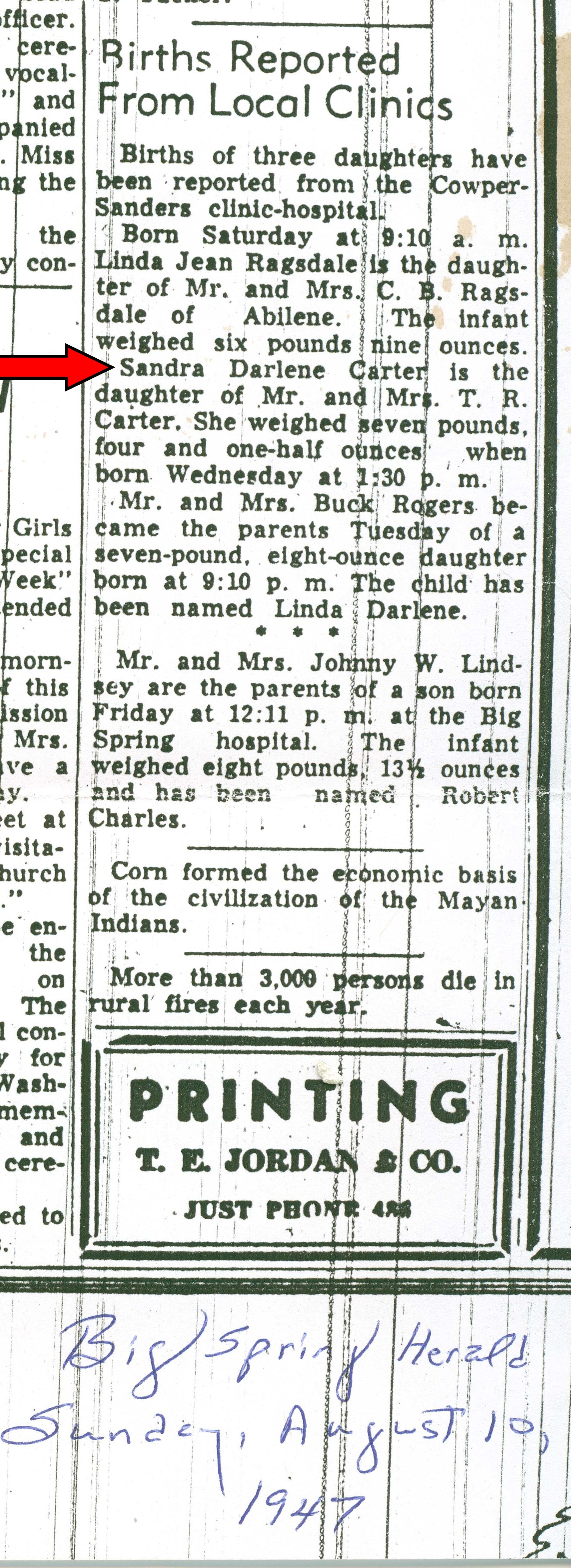
I may not have had
anyone left on this earth who could tell me who my mother’s biological father was,
but this little snippet in the newspaper put a smile on my face as I read my
mother’s name and saw how much she weighed when she was born as well as the
exact time of day. The newspaper article
also confirmed the father’s name was Carter. According to the article, his
initials were T.R. The R standing for Robert, I assumed, but I was not sure
what the T stood for. I began trying to search for a T. R. Carter living in
Waco during the time my mother would have been conceived. I found a few that
were possibilities but nothing that really fit. Once, I must have been desperate
and found a prison record for a Tex Carter from Big Springs, Texas who was
serving a sentence for bigamy. It didn’t seem to match but I kept the
information just in case. I tried just
about everything I could imagine. Since
the birth announcement article showed “Mr. and Mrs.”, I thought perhaps they
may have gotten married, so I searched for marriage records but found nothing
except my grandmother’s marriage to John Badeaux. The marriage record used her
maiden name and no record could be found with her being married to a Carter. Every
corner I turned ended up being a dead end. I searched city directories, census
records, courthouse records and every other record I could possibly think of.
There was not a record of a Robert Carter who would have fit the person I was
looking for. I had a lot of great clues and a lot of puzzle pieces. The problem
was that I just couldn’t find the right piece to finish my puzzle. In great
frustration, I set it aside and began working on other branches of my family
tree.
Fast forward a few years to around the
year 1998. I decided to give it another go. I began writing and making phone calls
to my aunts once again hoping something I said would trigger a memory, something
they didn’t think of before. I asked them to tell me about my mother when she
was little. One of my aunts told me that she used to babysit my mother while my
grandmother worked at the sewing factory. She remembered that the Carter family
(my mother’s biological father’s Carter family) lived across the street from
their house. My aunt said that “whenever the old lady (assuming she meant a
grandmother) was visiting, she would come knock on our door wanting to see your
mother”. My grandmother told them to
keep my mother hidden so they couldn’t see her, and so they did. I wish they
had remembered this bit of information earlier, but at least now I had a lot
more to go on. I knew I could figure this out now.
As soon as I could manage it, I went to
the genealogy library in Waco. My youngest daughter was in gymnastics at the
time so I would drop her off at her practice and drag my other two daughters
with me to the library. I began looking through
old telephone directories to find a listing for my aunt. Once I found a listing
for her, I made a note of the address. The next thing I did was to find the
location on a city map. I had to figure out what the address would have been to
the house directly across the street. After finding what I needed, It was back
to the telephone directory. I went through every listing of the Carter name looking
for that street address. There it was in
black and white. Claud and Juanita
Carter were living directly across the street from my aunt. I had the right
family, now all I had to do was to find a Robert who was a member of this
family. Easier said than done. I began the long process of researching this
family. Beginning by looking up census
records, then birth records, death records, obituaries, newspapers, etc. There
were only two people with the name Robert in this family that I could find. One
of them was a nephew to neighbor Claud and would have been about 6 or 7 years
old at the time of my mother’s conception, so he was out. The other Robert was
an uncle to neighbor Claud. He may have been a contender, although he was old
enough to be my grandmother’s father, he was not living anywhere close to the
area. There was another problem with this Robert Carter, his full name was Robert
Jackson Carter. It didn’t match the birth announcement. There was another clue
from the beginning that I thought might help prove that I was a least on the
right track with this Carter family. My dad had remembered that he was told
that the biological father worked at the family’s business in Waco. The next
trip to the library was spent looking through telephone directories and pouring
over microfilmed newspaper from 1940’s and 1950’s looking for any type of
advertising that would reveal any clues for this Carter family and their
business.
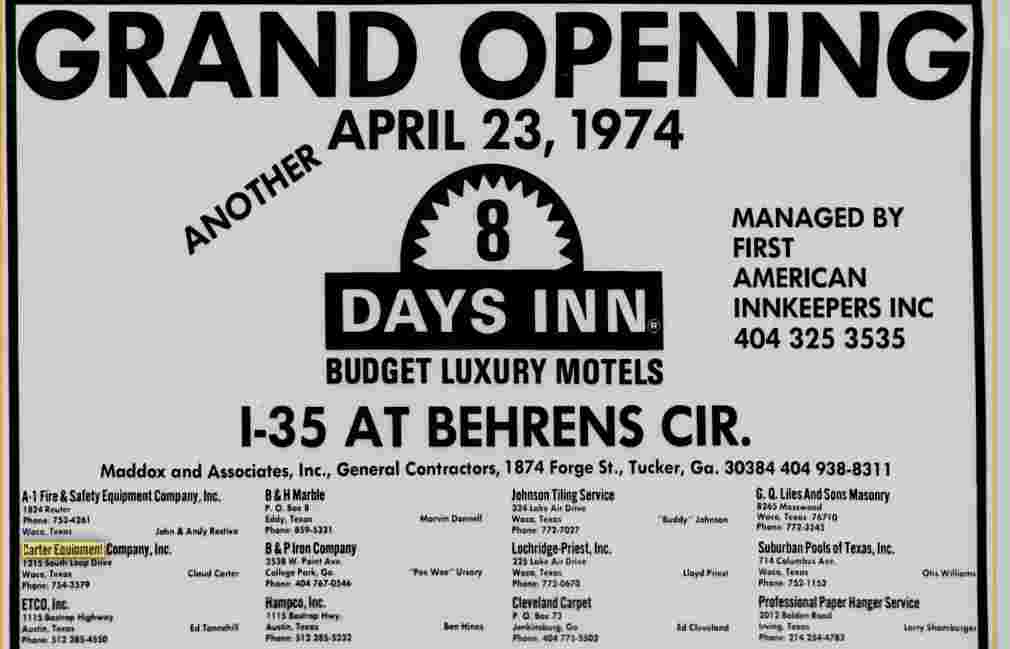
I found
a listing for Carter Equipment Company, Inc with the name Claud Carter as the
owner. This confirmed that there was a family owned business associated with
the neighbor. I was convinced that I had the correct family, but just couldn’t
figure out where my Robert Carter fit it.
I spent the next several years researching
the ancestors of the neighbor, Claud Carter. I researched every branch of this
man’s family tree until I became very familiar with all the names. A few years
into researching this family, I came across someone who had a family tree
online. They had listed the neighbor, Claud Carter as their father. I started
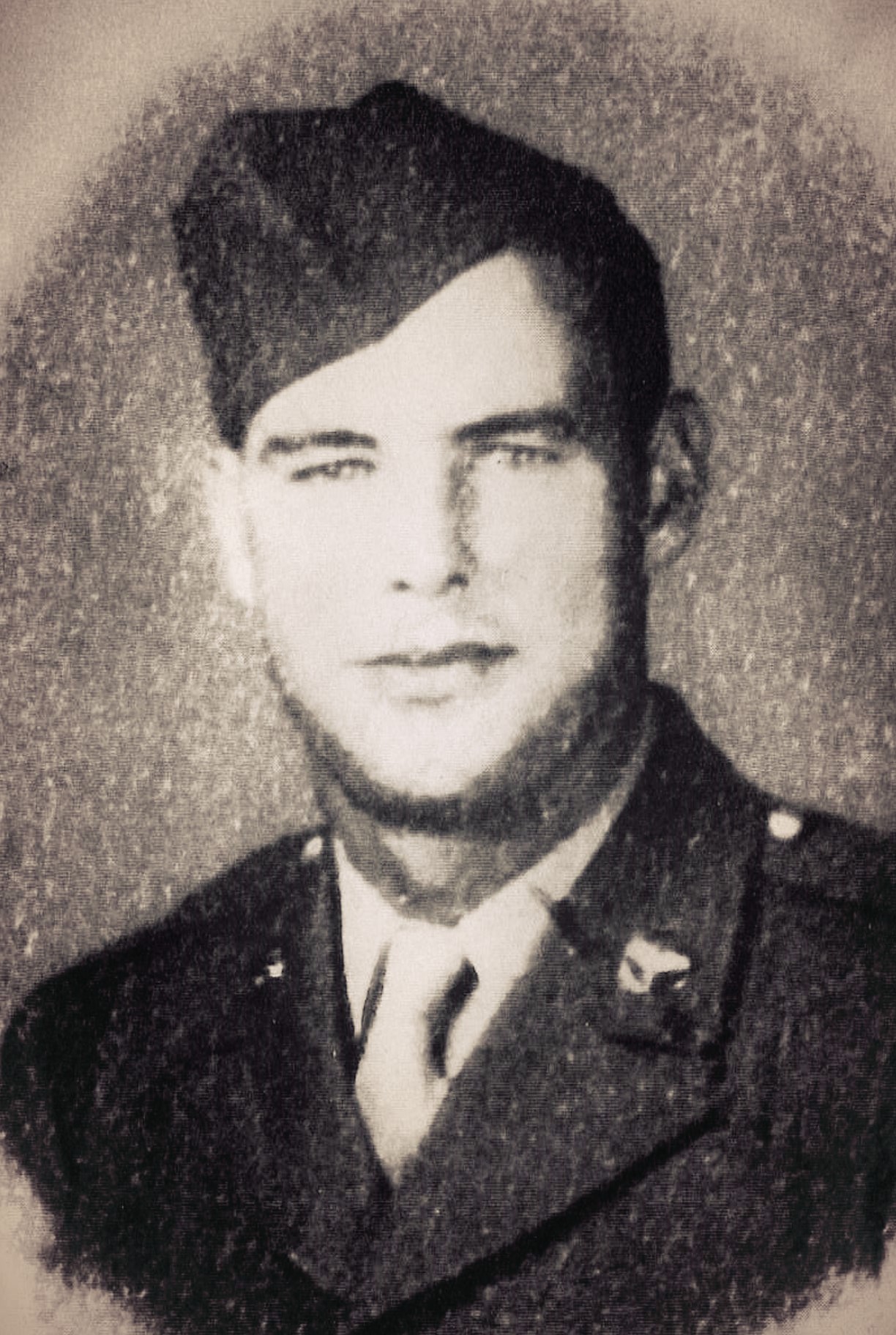
pouring over their tree and came across a picture with the caption “Robert Carter”
underneath. When I saw the picture, my jaw nearly hit the floor. My mother
looked so much like him. I knew I finally found my Robert Carter.
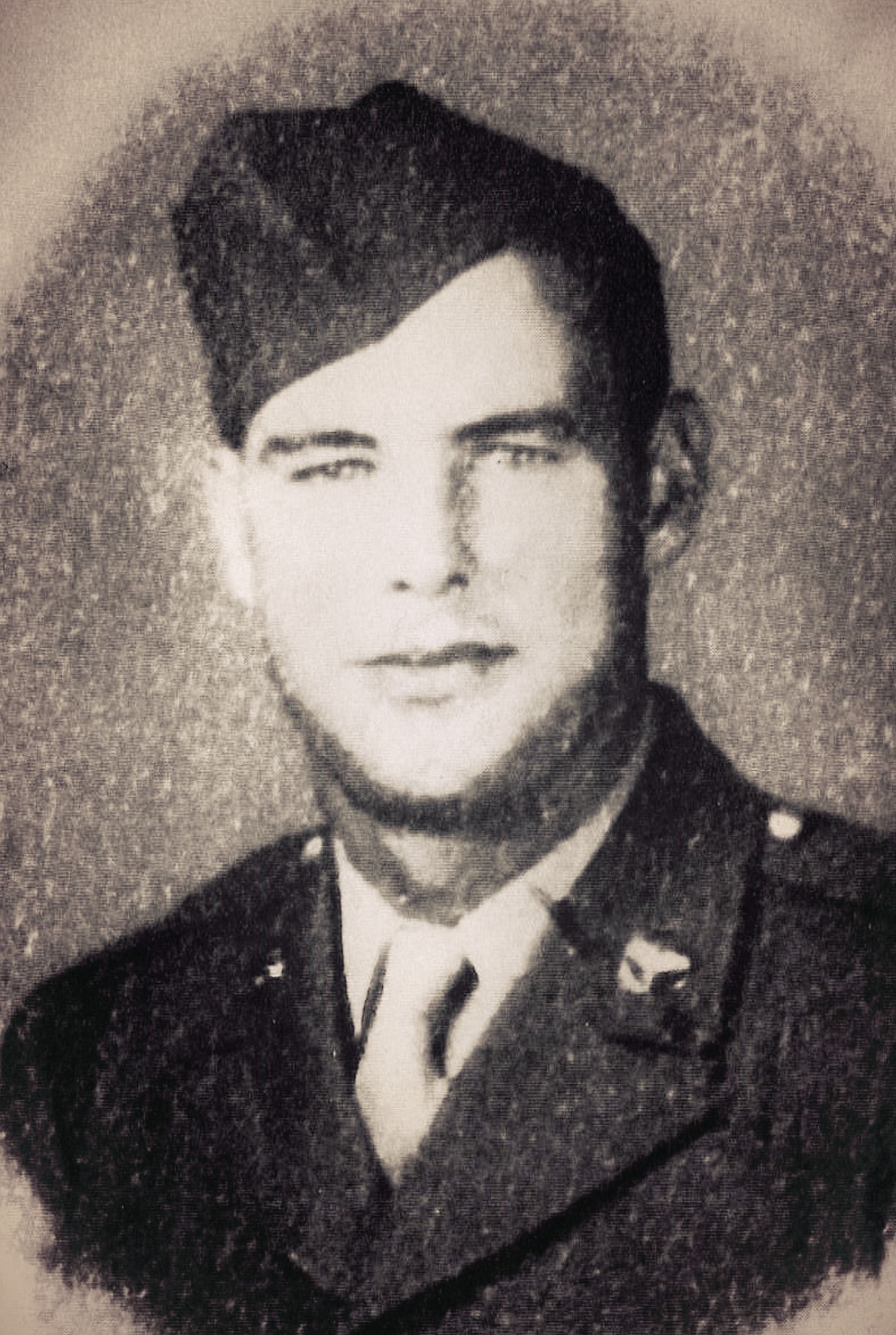
This photo was labeled “Robert Carter”
I contacted the owner of the family tree by email. She immediately wrote back to me. I told her my mother’s story and she told me her story in return. The stories seemed very similar. There was an affair that resulted in an illegitimate birth. She told me that her father, Claude Carter, Jr. was still living and that she would introduce me to him. I asked her about the photo she had labeled as Robert Carter. She said that he was her father’s brother, but he was no longer living. I was a little confused and thought that I must have missed something because I did not find this Robert anywhere in my research. I knew that Claude Jr. had a brother named Therman Aubrey Carter but had never seen a picture of him. I also knew that Therman had a son named Robert who was about 7 years old when my mother was born. I started thinking back to the newspaper article about my mother’s birth announcement. It said, “Mr. and Mrs. T.R. Carter”. Could the “T” have stood for Therman and might the “R” have been a misprint that maybe should have been an “A” instead? Perhaps he told my grandmother his name was Robert? I didn’t really know at this point, only speculation. I did know that I had the correct Carter family and that my mother looked just like the man in the picture. The owner of the family tree called her father and set up a time and place for us to meet. We met for lunch at Cracker Barrel restaurant in Waco. I had printed the picture of “Robert Carter” from the family tree so that Claude Jr. could identify it for me. He immediately said that it was his brother, but his name wasn’t Robert, it was Therman. He had no idea why his daughter labeled it Robert. I was a bit disappointed, but deep in my heart I knew that Therman had to be my mother’s biological father. We had a nice lunch and conversation. He told me about himself and his family. I asked him if he had ever heard of my grandmother, which he hadn’t. I left feeling disappointed but somehow content. I put the little picture in a frame and put it on my shelf along with other family photos. I felt that I had given it everything I could and felt that I would be ok with that.
I continued to work on the Carter family tree along with other branches of my family for the next several years. Fast forward to the year 2015 when DNA testing was more affordable. I decided to take the plunge to see if I could confirm this Carter connection. The wait time seemed eternal, but after finally getting the notification that my results were complete, I could hardly wait for them to download. I clicked on my matches and started seeing the names I recognized as being in the Carter family tree…. Carter, Westbrook, Goodnight, Day!! I knew I had it right. There was no doubt about it now. I looked for the girl who was the owner of the Carter family tree as she told me she had taken a DNA test. She was nowhere on my match list. I found it strange that she didn’t match. My top DNA match at the time was someone with the username “whiteelkglass”. I had no earthly idea who that was. He was a very close match, so I decided to write to him to find out exactly who he was. He wrote back to me telling me his name and I found out that he was the grandson of Therman Aubrey Carter. This all finally made some sense now. My “Robert Carter” was Therman all along. I wanted to be 100% certain so I decided that I would try to figure out a way to get my mother’s adoption records unsealed. I knew it would probably be a huge expense to hire a lawyer, but at my husband’s urging, I decided that I would go ahead and do it. I contacted a lawyer’s office and made an appointment. The lawyer informed me that I had to petition the judge from the jurisdiction my mother was adopted in and that I had to have a good reason for wanting to uncover the adoption. Doing it for genealogical purposes wasn’t one of them. My mother had several medical conditions that may have very well been inherited. The petition was made to the judge to unseal the adoption records for the purpose of obtaining medical history. The lawyer wrote the petition and I waited (most impatiently). It didn’t take long to get an answer. I received a call from the lawyer’s office letting me know that I had an answer to my petition. I couldn’t even wait to drive to the office, I had the secretary open the letter and tell me over the phone, right then and there, I had to know immediately. She said these exact words, “It says that the natural father is Therman Carter of Waco, Texas”. Before my emotions took over, I let her know that I would be there shortly to pick up the paperwork and pay them the fees. After I hung up the phone I started crying and screeching. I’m sure I did some jumping up and down and running around the house. I knew that I knew that I knew it had to be him. For the cost of about $125 and about two weeks waiting time, I found out what I spent twenty years looking for.
After I calmed down, the thought came to me.
If his name was on the adoption papers as the natural father, my grandmother had
to have known all along what his real name was. Why did she try so hard to keep
his name a secret? What had she gone through with this man that she was
determined to keep her daughter hidden from? Now that I had one mystery finally solved, it
presented more questions, which I eventually uncovered.
Once I knew the exact person to focus on,
I gathered everything I had on Therman, which wasn’t much. I knew that he
passed away in 1983, just 6 months before my mother. I headed to the genealogy
library in Waco to find his obituary in the microfilmed newspaper.
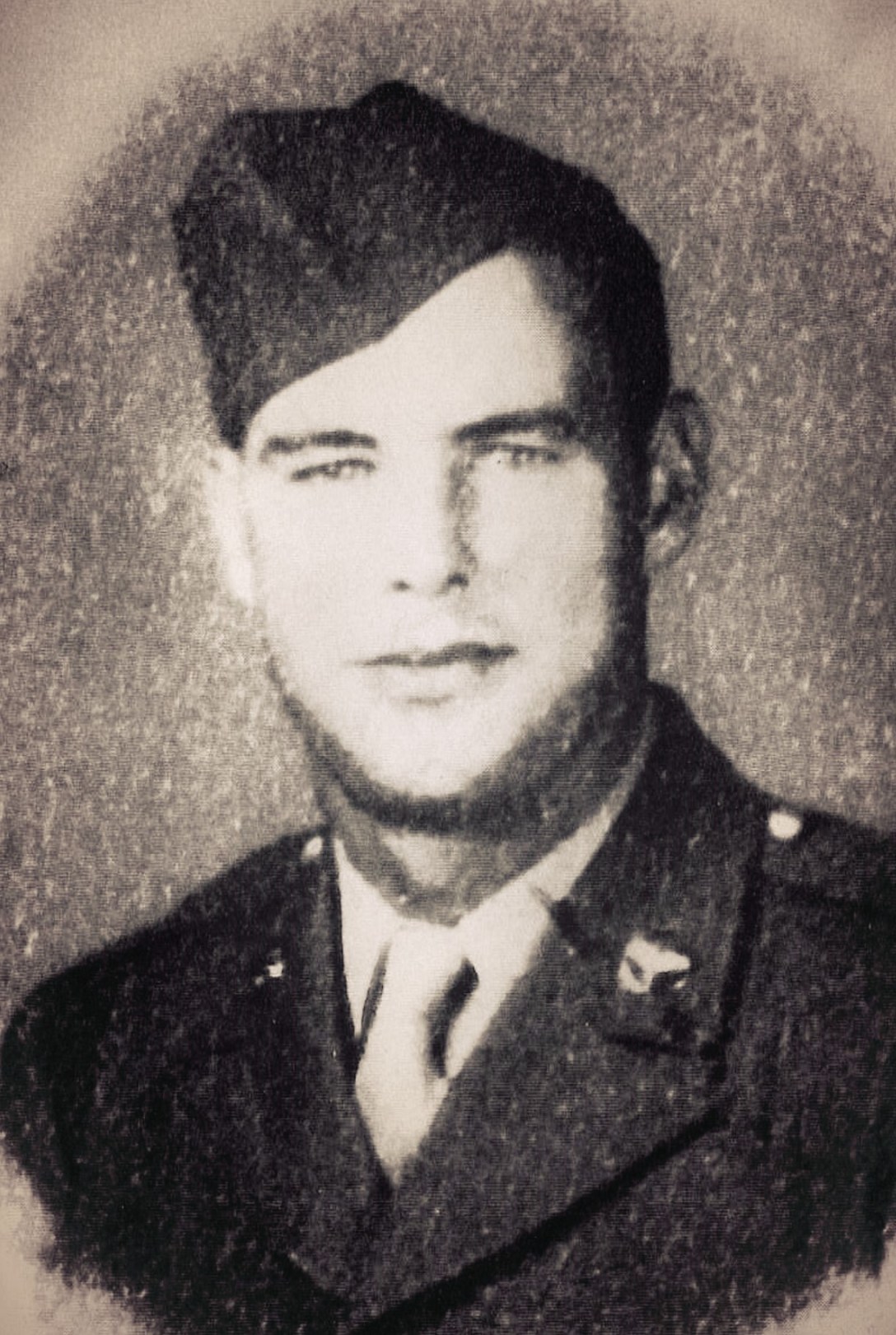
“Thermen Aubrey Carter, 68 of 1822 Windsor died Monday at a Temple hospital. Services will be at 10 a.m. Thursday at Connally-Compton Downtown Chapel, Bert Mercer officiating. Burial will be at Rosemound Cemetery. Mr. Carter was a World War II veteran and was a foreman for Brown and Root for 20 years. He was a member of American Legion Post No. 121 and Veterans of Foreign Wars. He was a member of the Church of Christ. Survivors include three daughters, Myrl Holmes of Garland, Patricia Korenek of West and Jeanie Grillett of Houston; five sons, Robert Carter of Lancaster, Therman Carter, Jr. of Jefferson City, Mo., James Carter of Lufkin, Louis David Carter of San Francisco and Kurt Daniel Carter of Bryan; three sisters, Dorothy Parks, Opal McCutchen and Melba Bettinger, all of Waco; a brother, Claude W. Carter of Waco; 19 grandchildren; and three great-grandchildren.”
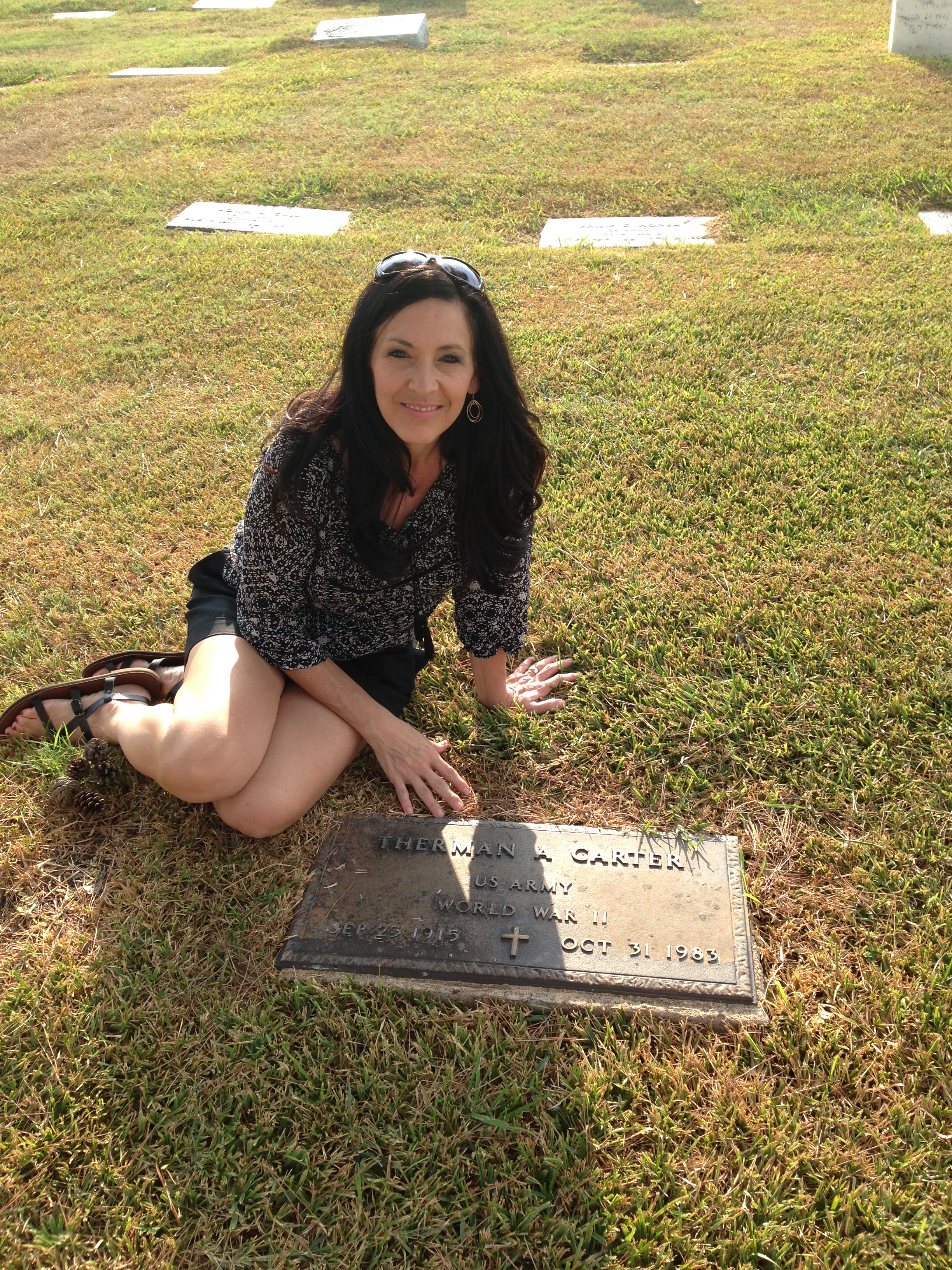
Since I was already in Waco when I found the obituary, I decided that I would try to find his grave. After arriving at the cemetery, I realized how huge it was and that it may take a while to locate. After spotting the military veterans’ section, I decided to take a chance and check there. Once I found his headstone, I had a flood of emotion. After twenty years, I had found him. There were still so many unanswered questions, but at least I finally found Therman.
Independent
Week #27 of Amy Johnson Crow’s
52 Ancestors in 52 Weeks Series
This week’s prompt is “Independent” and as Independence Day is approaching, I decided to write about my first NSDAR proven Revolutionary War Patriot, David Carter, who fought to make America an Independent nation.
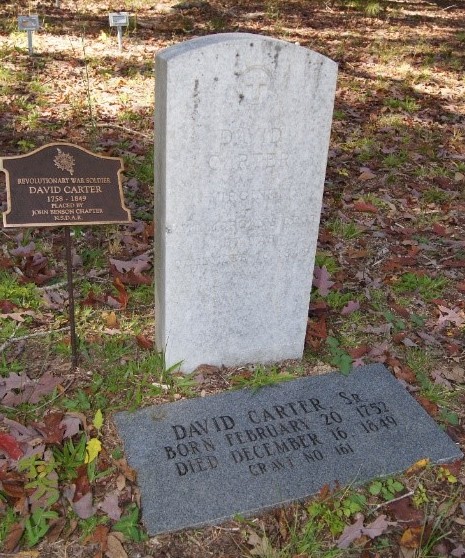
(Grave marked by the Daughter’s of the American Revolution)
David Carter was born in East Orange, Essex County, New Jersey in 1758.[1] His parentage has not yet been verified. Several family trees that I have come across online have recorded him as being the son of Solomon Carter of Duplin County, North Carolina. This may be due to a probate record for Solomon Carter listing a David Carter as an heir .[2] The connection between this Solomon Carter and my ancestor David Carter is disproven according to the DAR database[3] listing this particular Solomon Carter with a son David whose birthdate is listed as 1775 and a death date of 1840 in Tishomingo Co MS. This does not match my ancestor, David Carter’s birth or death information. A guardianship record[4] from a New Jersey Abstract of Wills dated 6 May 1772, states, “David and Stephen Carter, sons of Benjamin Carter request their guardian to be Samuel Potter”. According to the date for David Carter’s birth in 1758, would make him 14 years old at the time of this record. Further research is needed in order to either establish that Benjamin Carter is the father of my ancestor, David Carter, or to disprove it.
David moved from New Jersey to Pennsylvania and then to Monogalia County, Virginia (what is now West Virginia) arriving around 1770.[5] This was known as the Ohio Valley.
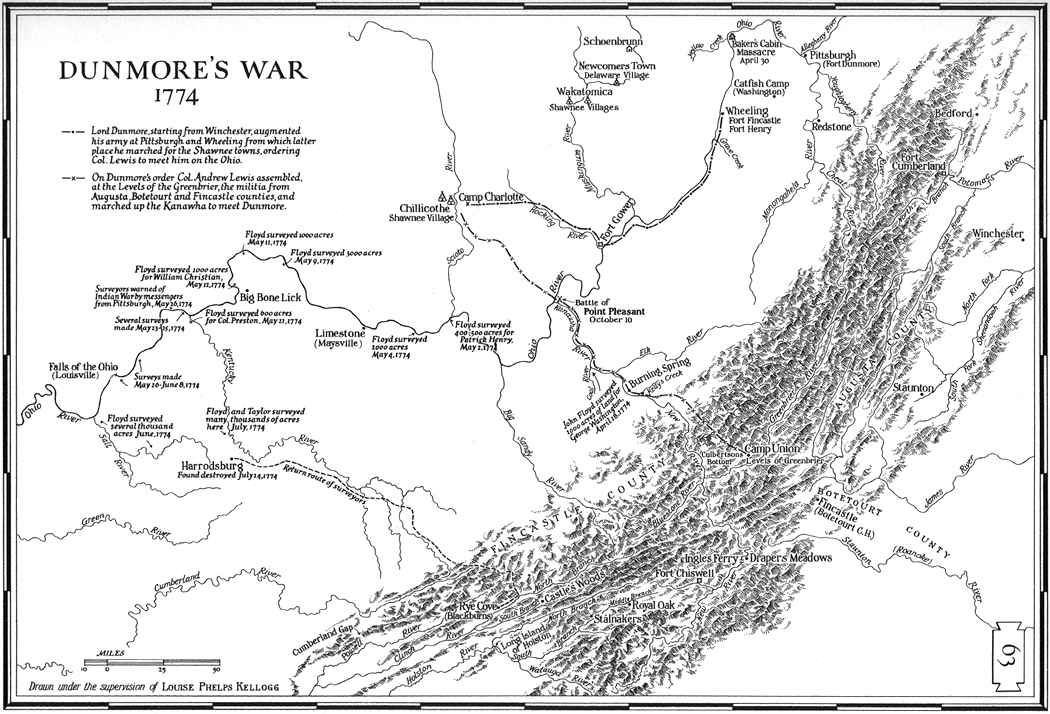
“The Ohio Valley was the key to the possession of the continent. The ten years of comparative peace following the close of the French and Indian War disclosed a continual movement from eastern Virginia to western Virginia, and a like movement down along the Ohio River from the Pittsburgh entrance. The old line of defense fell more or less into disuse. Then came the hectic days of 1774, and a new outbreak between the settlers and the Indians, called Dunmore’s War, of which the most important episode was the Battle of Point Pleasant. A new line of defense was then developed, running from Fort Pitt, and “old Fort Redstone,” following generally the Monongahela and West Fork of the Monongahela, and the Ohio Valley, together with the regions along the Great Kanawha as far west as Maysville, Kentucky. In western Virginia there then sprang up a long series of forts, stockades, and blockhouses, located at strategic points to safeguard the pioneer settlers in this region.”[6]
His first military service was in Monogalia County, Virginia[7] where he is shown to be a private serving three months in the fall of 1774 and one month in the spring of 1775 under Colonels Morgan and Lewis. This was the time during which Dunmore’s War took place. Dunmore’s War was a confrontation between Virginia and the American Indians of Ohio Country.[8]
“In August 1774, Pennsylvania militia entered the Ohio Country and quickly destroyed seven Seneca-Cayuga villages, which the Seneca-Cayuga had abandoned as the soldiers approached. At the same time, Lord Dunmore sent one thousand men to the Kanawha River in modern-day West Virginia to build a fort and to attack the Shawnee. Cornstalk, who had experienced a change of heart toward the white colonists as the soldiers invaded the Ohio Country, sent nearly one thousand warriors to drive Dunmore’s force from the region. The forces met on October 10, 1774, at what became known as the Battle of Point Pleasant. After several hours of intense fighting, the British drove Cornstalk’s followers north of the Ohio River. Dunmore, with a large force of his own, quickly followed the Shawnee across the river into the Ohio Country. Upon nearing the Shawnee villages on the Pickaway Plains north of modern-day Chillicothe, Ohio, and near what is now Circleville, Ohio, Dunmore stopped. From his encampment named Camp Charlotte, Dunmore requested that the Shawnee come to him and discuss a peace treaty. The Shawnee agreed, but while negotiations were under way, Colonel Andrew Lewis and a detachment of Virginia militia that Dunmore had left behind at Point Pleasant crossed the Ohio River and destroyed several Shawnee villages. Fearing that Dunmore intended to destroy them, the Shawnees immediately agreed to terms before more blood was shed.”[9]
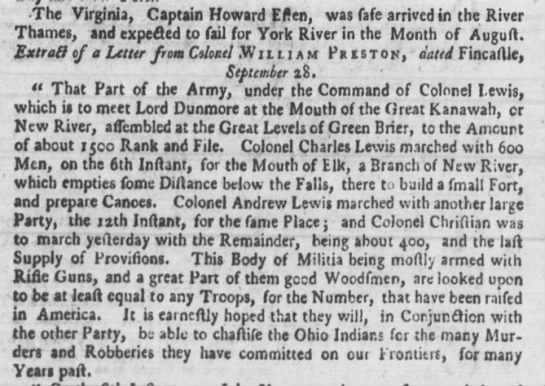
(Clipping from The Virginia Gazette Williamsburg, Virginia 13 Oct 1774, Thu • Page 2)
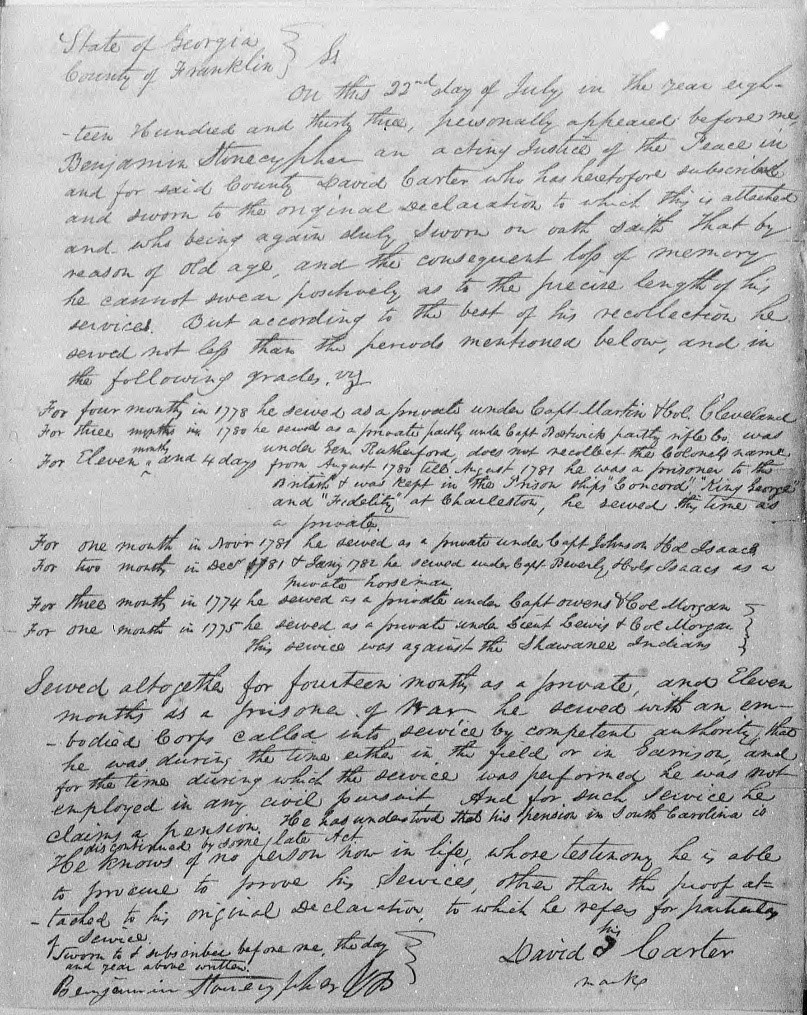
David Carter sees his next service in the spring of 1778 for four months “where he was kept out scouting after the Tories”[10] and in the summer of 1780, both times under Captain Martin and Major Lewis in North Carolina.
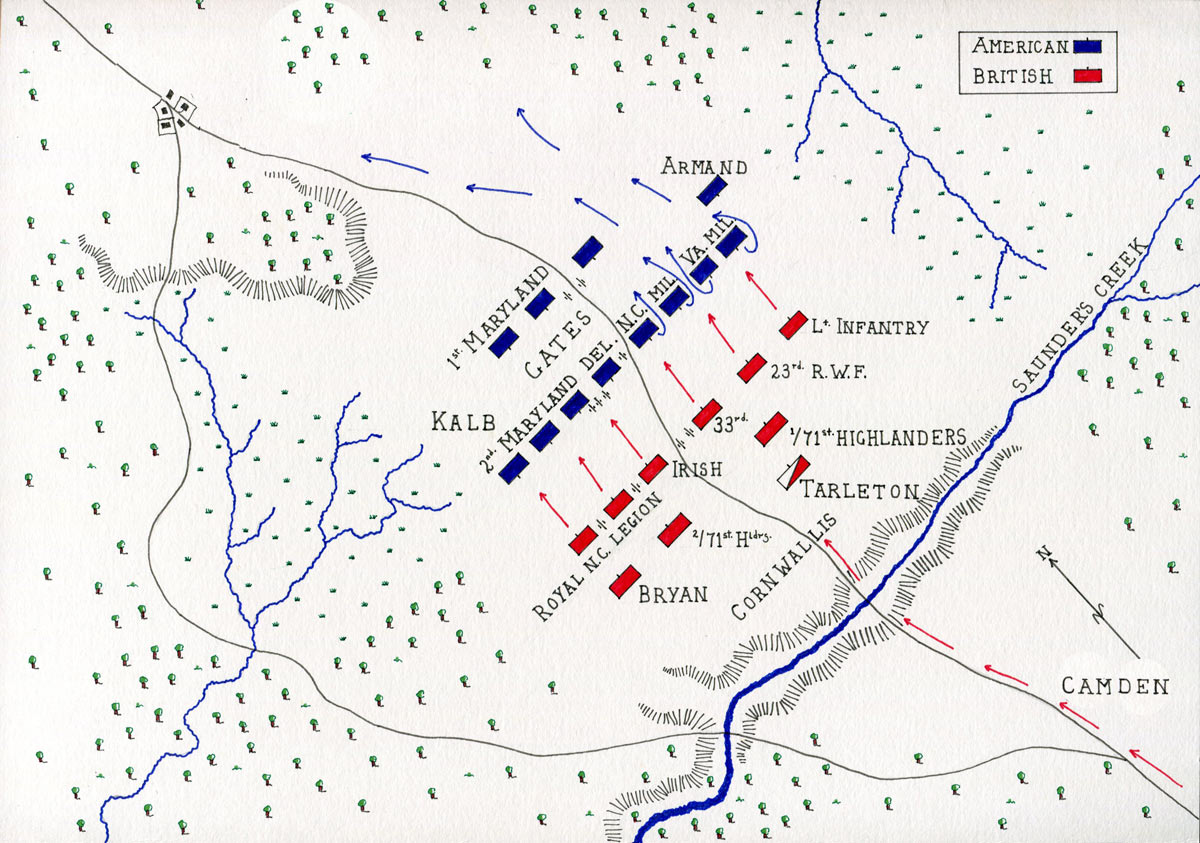
On August 16, 1780, the Battle of Camden erupted. David Carter was part of the North Carolina Militia under General Griffith Rutherford. The militia defended their positions gallantly but was forced to retreat with heavy losses. General Griffith Rutherford was captured[11] along with several of his militia including David Carter.[12]
The prisoners taken from the Battle of Camden were housed aboard prison ships anchored in various places in Charleston harbor in South Carolina[13]. David Carter stated in his military pension application that he was held “in the prison ships eleven months and four days”.[14] He was kept on the prison ships Concord, King George and Fidelity.[15]
After almost a year of being a prisoner, he was carried to Jamestown, Virginia where he was exchanged in August 1781.[16] After being exchanged, “he returned home after a total service of fifteen months during this campaign”.[17] He took up arms once again in November and December 1781 under Colonel Isaacs[18] fighting in several more skirmishes before the end of the war.
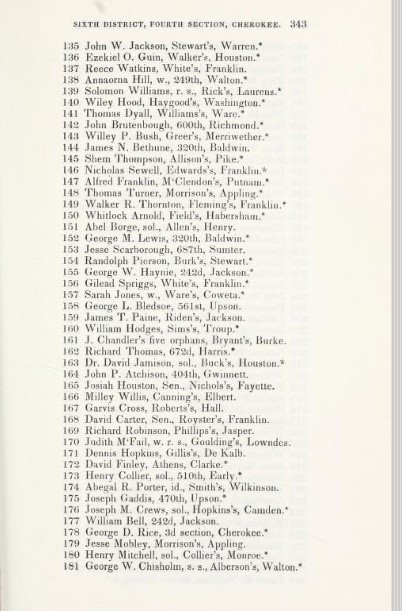
Sometime before 1787, David Carter married Mehitable Cobb[19]. Their son Micajah Carter was born on 30 May 1787 in Pendleton District, South Carolina.[20] David Carter’s family is listed in the 1790 U.S. Federal Census living in Pendleton, South Carolina with one white male age 16 and over, two white males under age 16, 4 white females and twenty-three slaves[21]. Between 1820 and 1830, David Carter moved with his family to Franklin County, Georgia.[22] He received land through the Cherokee Land Lottery in 1832.[23] David was “allowed two draws under the condition of being a veteran of Revolutionary War”[24]
(Cherokee Land Lottery by James F. Smith pg. 343 line 168)
The 1840 census shows his home listed in Elbert County, Georgia[25] living in a household with two females, one of which is most likely his wife as she did not die until between 1848-1849 [According to records from the old family Bible of James M. Carter]. At the time of his death in 1849, he was residing at the home of his son, Micajah Carter, in Franklin County, Georgia[26]. He passed away at the age of 91 years on 16 December 1849 of dyspepsia[27] . He was originally buried in Mt. Zion Methodist Church Cemetery but because of construction of the Hartwell Dam and Lake in 1960, his remains were moved to New Harmony Church Cemetery.[28]
I feel as though there is still so much to learn about my Revolutionary War ancestor. To have been taken prisoner and kept in the bottom of a filthy, rocking ship for almost a year must have been quite a hardship. He not only overcame the odds and survived the battles he fought, being a prisoner constantly surrounded by death and sickness on a daily basis, living off scant rations and dodging all the diseases that ran rampant during his imprisonment; but went back to fight more battles until the end of the war, until he saw victory and freedom. When we look at the records of our ancestors, we really can’t get a feeling for what type of character they had. I have learned one thing about my ancestor, David Carter; he was a fighter. He didn’t give up or give in. We owe our American Independence to men like this. To all the men and women who stood up for our rights and our freedom and for those who stand today and serve in our armed forces, I salute you and I thank you!!
[1] U.S. Revolutionary War Pension and Bounty-Land Warrant Application Files 1800-1900; Carter, David S16335; pension year 1833 state of Georgia; archive publication number M804; archive roll 483; Records of the Department of Veterans Affairs, Record Group 15. National Archives, Washington, D.C. imaged at Ancestry (https://www.ancestry.com); 2007; Provo, UT, USA pg. 555-578; [accessed 4 July 2019]
[2] Wills and Estate Papers (Duplin County), 1663-1978; Author: North Carolina Division of Archives and History (Raleigh, North Carolina); Probate Place: Duplin, North Carolina; Solomon Carter, probate date 1809, Wills and Estate Papers; Ancestry [database on-line]. Provo, UT, USA: Ancestry.com Operations, Inc., 2015 (https://www.ancestry.com) ;North Carolina County, District and Probate Courts; [accessed 4 July 2019]
[3]Daughters of the American Revolution, “Ancestor Database.” database, Genealogical Research System (http://services.dar.org/public/dar_research/ : [accessed 4 July 2019]), [Carter, Solomon, A020064].
[4] New Jersey State Archives. New Jersey, Published Archives Series, First Series. Trenton, New Jersey: John L Murphy Publishing Company; David Carter, 6 May 1772, Essex, New Jersey, United States; Images [online database] Ancestry (https://www.ancestry.com) New Jersey, Abstract of Wills, 1670-1817 [accessed 4 July 2019]. Provo, UT, USA: Ancestry.com Operations, Inc., 2011.
[6] West Virginia Dept of Arts, Culture and History; West Virginia History; Publication of West Virginia Archives and History; Virginia Frontier Defenses 1719-1795 by Roy Bird Cook; Vol. 1 No. 2 Jan 1940 pg. 119-130; http://www.wvculture.org/history/journal_wvh/wvh1-2-4.html; [accessed 4 July 2019]
[7] U.S. Revolutionary War Pension and Bounty-Land Warrant Application Files 1800-1900; Carter, David S16335; pension year 1833 state of Georgia; archive publication number M804; archive roll 483; Records of the Department of Veterans Affairs, Record Group 15. National Archives, Washington, D.C. imaged at Ancestry (https://www.ancestry.com); 2007; Provo, UT, USA pg. 555-578; [accessed 4 July 2019]
[8] Ohio History Central; Lord Dunmore’s War and the Battle of Point Pleasant; www.ohiohistorycentral.org; accessed on 4 July 2019
[10] U.S. Revolutionary War Pension and Bounty-Land Warrant Application Files 1800-1900; Carter, David S16335; pension year 1833 state of Georgia; archive publication number M804; archive roll 483; Records of the Department of Veterans Affairs, Record Group 15. National Archives, Washington, D.C. imaged at Ancestry (https://www.ancestry.com); 2007; Provo, UT, USA pg. 555-578; [accessed 4 July 2019]
[11] Encyclopedia of North Carolina; North Carolina Press 2006; The Battle of Camden; Denis Isenbarger; https://www.ncpedia.org/camden-battle; [accessed 4 July 2019]
[12] U.S. Revolutionary War Pension and Bounty-Land Warrant Application Files 1800-1900; Carter, David S16335; pension year 1833 state of Georgia; archive publication number M804; archive roll 483; Records of the Department of Veterans Affairs, Record Group 15. National Archives, Washington, D.C. imaged at Ancestry (https://www.ancestry.com); 2007; Provo, UT, USA pg. 555-578; [accessed 4 July 2019]
[13]Borick, Carl P. Relieve Us of This Burthen: American Prisoners of War in the Revolutionary South, 1780-1782; Columbia, South Carolina; University of South Carolina Press 1966
[14] U.S. Revolutionary War Pension and Bounty-Land Warrant Application Files 1800-1900; Carter, David S16335; pension year 1833 state of Georgia; archive publication number M804; archive roll 483; Records of the Department of Veterans Affairs, Record Group 15. National Archives, Washington, D.C. imaged at Ancestry (https://www.ancestry.com); 2007; Provo, UT, USA pg. 555-578; [accessed 4 July 2019]
[19] Daughters of the American Revolution, “Ancestor Database.” database, Genealogical Research System (http://services.dar.org/public/dar_research/ : [accessed 4 July 2019], Carter, David, A A019903
[21] First Census of the United States, 1790 (NARA microfilm publication M637, 12 rolls). Records of the Bureau of the Census, Record Group 29. National Archives, Washington, D.C.; Year: 1790; Census Place: Pendleton, South Carolina; Series: M637; Roll: 11; Page: 5; Image: 18; Family History Library Film: 0568151; Ancestry.com. 1790 United States Federal Census [database on-line]. Provo, UT, USA: Ancestry.com Operations, Inc., 2010. Images reproduced by FamilySearch; [accessed 4 July 2019]
[22] Fifth Census of the United States, 1830. (NARA microfilm publication M19, 201 rolls). Records of the Bureau of the Census, Record Group 29. National Archives, Washington, D.C.; 1830; Census Place: Franklin, Georgia; Series: M19; Roll: 17; Page: 245; Family History Library Film: 0007037; Ancestry [database on-line]. Provo, UT, USA: http://www.ancestry.com, 2010. [accessed 4 July 2019]
[23] The Cherokee land lottery, containing a numerical list of the names of the fortunate drawers in said lottery, with an engraved map of each district. By James F. Smith; Publication date 1838
[25] Sixth Census of the United States, 1840. (NARA microfilm publication M704, 580 rolls). Records of the Bureau of the Census, Record Group 29. National Archives, Washington, D.C.; Year: 1840; Census Place: Elbert, Georgia; Roll: 40; Page: 162; Family History Library Film: 0007043; Ancestry (http://www.ancestry.com) 1840 United States Federal Census [database on-line]. Provo, UT, USA, 2010. [accessed 4 July 2019]
[26] Seventh Census of the United States, 1850; (National Archives Microfilm Publication M432, 1009 rolls); Records of the Bureau of the Census, Record Group 29; National Archives, Washington, D.C.; Year: 1850; Census Place: District 32, Franklin, Georgia; Roll: M432_70; Page: 306B; Image: 143; Ancestry online database (https://www.ancestry.com); Provo, UT, USA, 2009 [accessed 4 July 2019]
[27] Federal Mortality Census Schedules and Related Indexes, 1850-1880. T655, 30 rolls. National Archives and Records Administration, Washington D.C.; National Archives and Records Administration (NARA); Washington, D.C.; Archive Roll Number: 7; Census Year: 1849; Census Place: Militia District 32, Franklin, Georgia; Page: 213; Ancestry [online database] (https://www.ancestry.com); Provo, UT, USA, 2010 [accessed 4 July 2019]
[28] Find A Grave, database and images (https://www.findagrave.com) [ accessed 05 July 2019], memorial page for David Carter, Sr (20 Feb 1752–16 Dec 1849), Find A Grave Memorial no. 25915432, citing New Harmony Methodist Church Cemetery, Reed Creek, Hart County, Georgia, USA.



 Digging Up Roots