
Independent
Week #27 of Amy Johnson Crow’s
52 Ancestors in 52 Weeks Series
This week’s prompt is “Independent” and as Independence Day is approaching, I decided to write about my first NSDAR proven Revolutionary War Patriot, David Carter, who fought to make America an Independent nation.
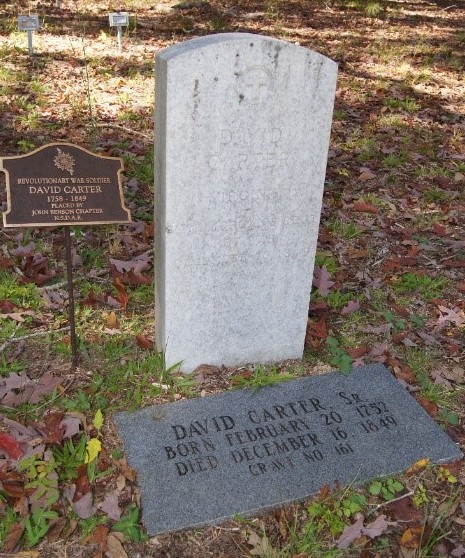
(Grave marked by the Daughter’s of the American Revolution)
David Carter was born in East Orange, Essex County, New Jersey in 1758.[1] His parentage has not yet been verified. Several family trees that I have come across online have recorded him as being the son of Solomon Carter of Duplin County, North Carolina. This may be due to a probate record for Solomon Carter listing a David Carter as an heir .[2] The connection between this Solomon Carter and my ancestor David Carter is disproven according to the DAR database[3] listing this particular Solomon Carter with a son David whose birthdate is listed as 1775 and a death date of 1840 in Tishomingo Co MS. This does not match my ancestor, David Carter’s birth or death information. A guardianship record[4] from a New Jersey Abstract of Wills dated 6 May 1772, states, “David and Stephen Carter, sons of Benjamin Carter request their guardian to be Samuel Potter”. According to the date for David Carter’s birth in 1758, would make him 14 years old at the time of this record. Further research is needed in order to either establish that Benjamin Carter is the father of my ancestor, David Carter, or to disprove it.
David moved from New Jersey to Pennsylvania and then to Monogalia County, Virginia (what is now West Virginia) arriving around 1770.[5] This was known as the Ohio Valley.
“The Ohio Valley was the key to the possession of the continent. The ten years of comparative peace following the close of the French and Indian War disclosed a continual movement from eastern Virginia to western Virginia, and a like movement down along the Ohio River from the Pittsburgh entrance. The old line of defense fell more or less into disuse. Then came the hectic days of 1774, and a new outbreak between the settlers and the Indians, called Dunmore’s War, of which the most important episode was the Battle of Point Pleasant. A new line of defense was then developed, running from Fort Pitt, and “old Fort Redstone,” following generally the Monongahela and West Fork of the Monongahela, and the Ohio Valley, together with the regions along the Great Kanawha as far west as Maysville, Kentucky. In western Virginia there then sprang up a long series of forts, stockades, and blockhouses, located at strategic points to safeguard the pioneer settlers in this region.”[6]
His first military service was in Monogalia County, Virginia[7] where he is shown to be a private serving three months in the fall of 1774 and one month in the spring of 1775 under Colonels Morgan and Lewis. This was the time during which Dunmore’s War took place. Dunmore’s War was a confrontation between Virginia and the American Indians of Ohio Country.[8]
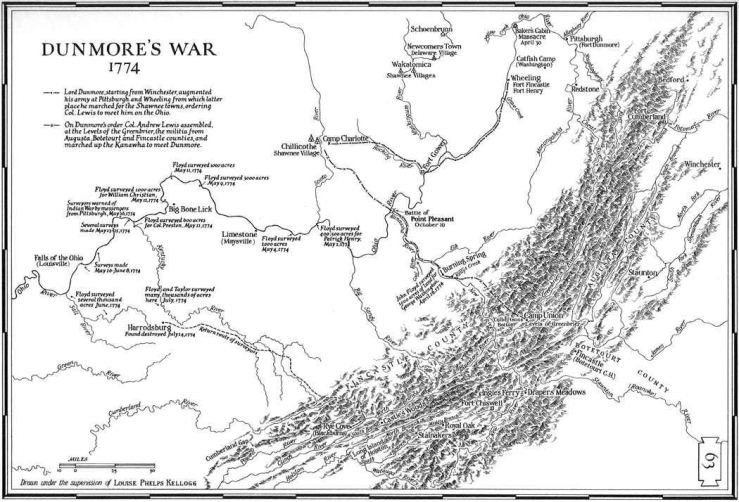
“In August 1774, Pennsylvania militia entered the Ohio Country and quickly destroyed seven Seneca-Cayuga villages, which the Seneca-Cayuga had abandoned as the soldiers approached. At the same time, Lord Dunmore sent one thousand men to the Kanawha River in modern-day West Virginia to build a fort and to attack the Shawnee. Cornstalk, who had experienced a change of heart toward the white colonists as the soldiers invaded the Ohio Country, sent nearly one thousand warriors to drive Dunmore’s force from the region. The forces met on October 10, 1774, at what became known as the Battle of Point Pleasant. After several hours of intense fighting, the British drove Cornstalk’s followers north of the Ohio River. Dunmore, with a large force of his own, quickly followed the Shawnee across the river into the Ohio Country. Upon nearing the Shawnee villages on the Pickaway Plains north of modern-day Chillicothe, Ohio, and near what is now Circleville, Ohio, Dunmore stopped. From his encampment named Camp Charlotte, Dunmore requested that the Shawnee come to him and discuss a peace treaty. The Shawnee agreed, but while negotiations were under way, Colonel Andrew Lewis and a detachment of Virginia militia that Dunmore had left behind at Point Pleasant crossed the Ohio River and destroyed several Shawnee villages. Fearing that Dunmore intended to destroy them, the Shawnees immediately agreed to terms before more blood was shed.”[9]
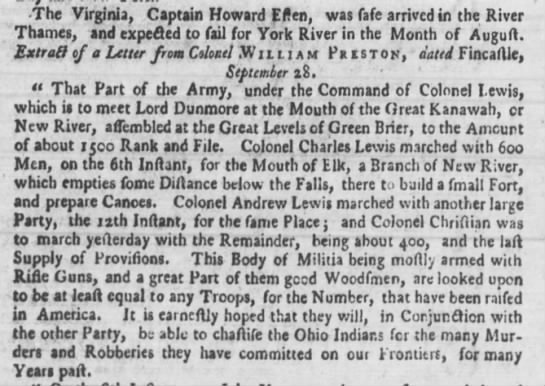
(Clipping from The Virginia Gazette Williamsburg, Virginia 13 Oct 1774, Thu • Page 2)
David Carter sees his next service in the spring of 1778 for four months “where he was kept out scouting after the Tories”[10] and in the summer of 1780, both times under Captain Martin and Major Lewis in North Carolina.
On August 16, 1780, the Battle of Camden erupted. David Carter was part of the North Carolina Militia under General Griffith Rutherford. The militia defended their positions gallantly but was forced to retreat with heavy losses. General Griffith Rutherford was captured[11] along with several of his militia including David Carter.[12]
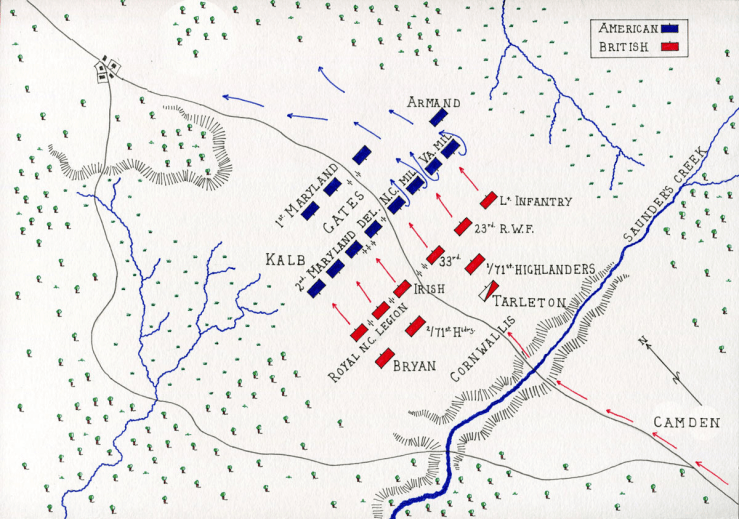
The prisoners taken from the Battle of Camden were housed aboard prison ships anchored in various places in Charleston harbor in South Carolina[13]. David Carter stated in his military pension application that he was held “in the prison ships eleven months and four days”.[14] He was kept on the prison ships Concord, King George and Fidelity.[15]
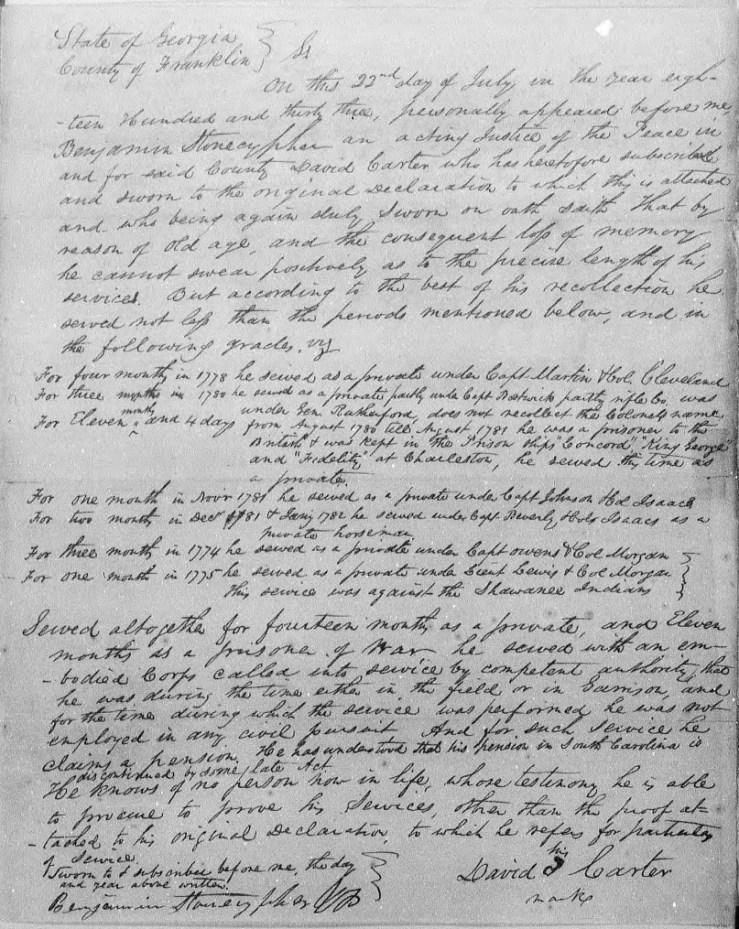
After almost a year of being a prisoner, he was carried to Jamestown, Virginia where he was exchanged in August 1781.[16] After being exchanged, “he returned home after a total service of fifteen months during this campaign”.[17] He took up arms once again in November and December 1781 under Colonel Isaacs[18] fighting in several more skirmishes before the end of the war.
Sometime before 1787, David Carter married Mehitable Cobb[19]. Their son Micajah Carter was born on 30 May 1787 in Pendleton District, South Carolina.[20] David Carter’s family is listed in the 1790 U.S. Federal Census living in Pendleton, South Carolina with one white male age 16 and over, two white males under age 16, 4 white females and twenty-three slaves[21]. Between 1820 and 1830, David Carter moved with his family to Franklin County, Georgia.[22] He received land through the Cherokee Land Lottery in 1832.[23] David was “allowed two draws under the condition of being a veteran of Revolutionary War”[24]
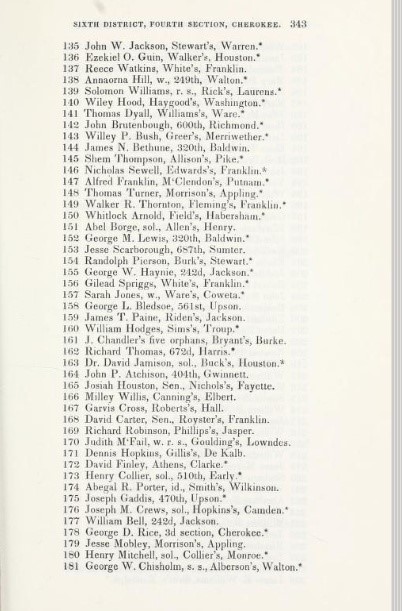
(Cherokee Land Lottery by James F. Smith pg. 343 line 168)
The 1840 census shows his home listed in Elbert County, Georgia[25] living in a household with two females, one of which is most likely his wife as she did not die until between 1848-1849 [According to records from the old family Bible of James M. Carter]. At the time of his death in 1849, he was residing at the home of his son, Micajah Carter, in Franklin County, Georgia[26]. He passed away at the age of 91 years on 16 December 1849 of dyspepsia[27] . He was originally buried in Mt. Zion Methodist Church Cemetery but because of construction of the Hartwell Dam and Lake in 1960, his remains were moved to New Harmony Church Cemetery.[28]
I feel as though there is still so much to learn about my Revolutionary War ancestor. To have been taken prisoner and kept in the bottom of a filthy, rocking ship for almost a year must have been quite a hardship. He not only overcame the odds and survived the battles he fought, being a prisoner constantly surrounded by death and sickness on a daily basis, living off scant rations and dodging all the diseases that ran rampant during his imprisonment; but went back to fight more battles until the end of the war, until he saw victory and freedom. When we look at the records of our ancestors, we really can’t get a feeling for what type of character they had. I have learned one thing about my ancestor, David Carter; he was a fighter. He didn’t give up or give in. We owe our American Independence to men like this. To all the men and women who stood up for our rights and our freedom and for those who stand today and serve in our armed forces, I salute you and I thank you!!

[1] U.S. Revolutionary War Pension and Bounty-Land Warrant Application Files 1800-1900; Carter, David S16335; pension year 1833 state of Georgia; archive publication number M804; archive roll 483; Records of the Department of Veterans Affairs, Record Group 15. National Archives, Washington, D.C. imaged at Ancestry (https://www.ancestry.com); 2007; Provo, UT, USA pg. 555-578; [accessed 4 July 2019]
[2] Wills and Estate Papers (Duplin County), 1663-1978; Author: North Carolina Division of Archives and History (Raleigh, North Carolina); Probate Place: Duplin, North Carolina; Solomon Carter, probate date 1809, Wills and Estate Papers; Ancestry [database on-line]. Provo, UT, USA: Ancestry.com Operations, Inc., 2015 (https://www.ancestry.com) ;North Carolina County, District and Probate Courts; [accessed 4 July 2019]
[3]Daughters of the American Revolution, “Ancestor Database.” database, Genealogical Research System (http://services.dar.org/public/dar_research/ : [accessed 4 July 2019]), [Carter, Solomon, A020064].
[4] New Jersey State Archives. New Jersey, Published Archives Series, First Series. Trenton, New Jersey: John L Murphy Publishing Company; David Carter, 6 May 1772, Essex, New Jersey, United States; Images [online database] Ancestry (https://www.ancestry.com) New Jersey, Abstract of Wills, 1670-1817 [accessed 4 July 2019]. Provo, UT, USA: Ancestry.com Operations, Inc., 2011.
[5] Biographical Sketch by Homer Hamilton Hall; Information shared on Ancestry (https://www.ancestry.com) [accessed 4 July 2019] member name hhhall11 ; family tree name: Hall Family Genealogy_2010-05-15 (https://www.ancestry.com/family-tree/person/tree/18062547/person/598791085/facts)
[6] West Virginia Dept of Arts, Culture and History; West Virginia History; Publication of West Virginia Archives and History; Virginia Frontier Defenses 1719-1795 by Roy Bird Cook; Vol. 1 No. 2 Jan 1940 pg. 119-130; http://www.wvculture.org/history/journal_wvh/wvh1-2-4.html; [accessed 4 July 2019]
[7] U.S. Revolutionary War Pension and Bounty-Land Warrant Application Files 1800-1900; Carter, David S16335; pension year 1833 state of Georgia; archive publication number M804; archive roll 483; Records of the Department of Veterans Affairs, Record Group 15. National Archives, Washington, D.C. imaged at Ancestry (https://www.ancestry.com); 2007; Provo, UT, USA pg. 555-578; [accessed 4 July 2019]
[8] Ohio History Central; Lord Dunmore’s War and the Battle of Point Pleasant; www.ohiohistorycentral.org; accessed on 4 July 2019
[9] ibid
[10] U.S. Revolutionary War Pension and Bounty-Land Warrant Application Files 1800-1900; Carter, David S16335; pension year 1833 state of Georgia; archive publication number M804; archive roll 483; Records of the Department of Veterans Affairs, Record Group 15. National Archives, Washington, D.C. imaged at Ancestry (https://www.ancestry.com); 2007; Provo, UT, USA pg. 555-578; [accessed 4 July 2019]
[11] Encyclopedia of North Carolina; North Carolina Press 2006; The Battle of Camden; Denis Isenbarger; https://www.ncpedia.org/camden-battle; [accessed 4 July 2019]
[12] U.S. Revolutionary War Pension and Bounty-Land Warrant Application Files 1800-1900; Carter, David S16335; pension year 1833 state of Georgia; archive publication number M804; archive roll 483; Records of the Department of Veterans Affairs, Record Group 15. National Archives, Washington, D.C. imaged at Ancestry (https://www.ancestry.com); 2007; Provo, UT, USA pg. 555-578; [accessed 4 July 2019]
[13]Borick, Carl P. Relieve Us of This Burthen: American Prisoners of War in the Revolutionary South, 1780-1782; Columbia, South Carolina; University of South Carolina Press 1966
[14] U.S. Revolutionary War Pension and Bounty-Land Warrant Application Files 1800-1900; Carter, David S16335; pension year 1833 state of Georgia; archive publication number M804; archive roll 483; Records of the Department of Veterans Affairs, Record Group 15. National Archives, Washington, D.C. imaged at Ancestry (https://www.ancestry.com); 2007; Provo, UT, USA pg. 555-578; [accessed 4 July 2019]
[15] ibid
[16] ibid
[17] ibid
[18] ibid
[19] Daughters of the American Revolution, “Ancestor Database.” database, Genealogical Research System (http://services.dar.org/public/dar_research/ : [accessed 4 July 2019], Carter, David, A A019903
[20] ibid
[21] First Census of the United States, 1790 (NARA microfilm publication M637, 12 rolls). Records of the Bureau of the Census, Record Group 29. National Archives, Washington, D.C.; Year: 1790; Census Place: Pendleton, South Carolina; Series: M637; Roll: 11; Page: 5; Image: 18; Family History Library Film: 0568151; Ancestry.com. 1790 United States Federal Census [database on-line]. Provo, UT, USA: Ancestry.com Operations, Inc., 2010. Images reproduced by FamilySearch; [accessed 4 July 2019]
[22] Fifth Census of the United States, 1830. (NARA microfilm publication M19, 201 rolls). Records of the Bureau of the Census, Record Group 29. National Archives, Washington, D.C.; 1830; Census Place: Franklin, Georgia; Series: M19; Roll: 17; Page: 245; Family History Library Film: 0007037; Ancestry [database on-line]. Provo, UT, USA: http://www.ancestry.com, 2010. [accessed 4 July 2019]
[23] The Cherokee land lottery, containing a numerical list of the names of the fortunate drawers in said lottery, with an engraved map of each district. By James F. Smith; Publication date 1838
[24] Georgia Archives University System of Archive (https://www.georgiaarchives.org/research/1832_land_lottery); Georgia Archives, 5800 Jonesboro Road, Morrow, GA U.S.A. ; 2019 [accessed 5 July 2019]
[25] Sixth Census of the United States, 1840. (NARA microfilm publication M704, 580 rolls). Records of the Bureau of the Census, Record Group 29. National Archives, Washington, D.C.; Year: 1840; Census Place: Elbert, Georgia; Roll: 40; Page: 162; Family History Library Film: 0007043; Ancestry (http://www.ancestry.com) 1840 United States Federal Census [database on-line]. Provo, UT, USA, 2010. [accessed 4 July 2019]
[26] Seventh Census of the United States, 1850; (National Archives Microfilm Publication M432, 1009 rolls); Records of the Bureau of the Census, Record Group 29; National Archives, Washington, D.C.; Year: 1850; Census Place: District 32, Franklin, Georgia; Roll: M432_70; Page: 306B; Image: 143; Ancestry online database (https://www.ancestry.com); Provo, UT, USA, 2009 [accessed 4 July 2019]
[27] Federal Mortality Census Schedules and Related Indexes, 1850-1880. T655, 30 rolls. National Archives and Records Administration, Washington D.C.; National Archives and Records Administration (NARA); Washington, D.C.; Archive Roll Number: 7; Census Year: 1849; Census Place: Militia District 32, Franklin, Georgia; Page: 213; Ancestry [online database] (https://www.ancestry.com); Provo, UT, USA, 2010 [accessed 4 July 2019]
[28] Find A Grave, database and images (https://www.findagrave.com) [ accessed 05 July 2019], memorial page for David Carter, Sr (20 Feb 1752–16 Dec 1849), Find A Grave Memorial no. 25915432, citing New Harmony Methodist Church Cemetery, Reed Creek, Hart County, Georgia, USA.
 Digging Up Roots